

Course category
Social
16 courses
Topics

All Religions Advocate for Serving the Underserved
Throughout history, religion has served as a moral compass guiding the behaviors, attitudes, and actions of humanity. Despite the diversity of religious traditions, a common thread running through all of them is the call to compassion, kindness, and service—especially towards the underserved.From the teachings of Christianity to the practices in Sikhism, serving the underserved is a cornerstone of spiritual life across all major religions. Whether through the concept of Zakat in Islam, Seva in Sikhism, or Tzedakah in Judaism, the focus remains clear: helping the poor, needy, and marginalized is not just encouraged but required as an expression of faith and righteousness.
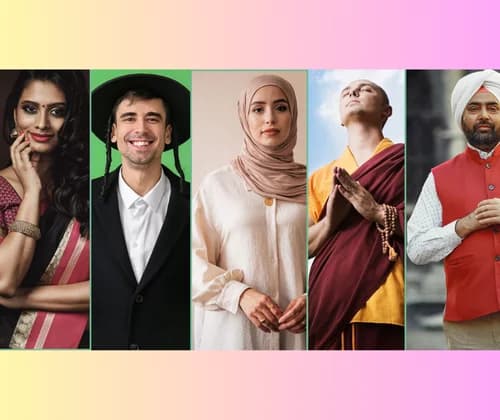
Clothing
Religious clothing is more than a mere covering. It is a powerful visual expression of faith, community, and identity. Religious wear can also embody profound ideas and practices, such as reverence, modesty, humility, devotion, and renunciation. Religious clothing can also be a source of strength and comfort for many people. Religious garbs can help them to feel connected to their faith community and to their religious values. Religious clothes can also be a way to express their individuality and their unique relationship with God.

Common Threads Across All Religions
So many religions, so many paths to reach the same goal. I have practiced Hinduism, Islam, Christianity, and in Hinduism again, the ways of the different sects. I have found that it is the same God towards whom all are directing their steps, though along different paths. -Swami Ramakrishna, Hindu Monk

Concept of One God
Religion is often associated with the concept of God, but there are many different conceptions of God. Children are naturally curious about different religions and can easily incorporate the concepts of different religions into their lives. As adults, we should also be open to learning about different religions and respecting the beliefs of others. All religions are essentially searching for the same ultimate truth, even if they use different names and metaphors to describe it. We should embrace diversity and pluralism in religion, and see different religions as different expressions of the same human yearning for meaning.

Conversion and Proselytization
Philosopher Arthur Schopenhauer believed that since our intellect imposes differences on the universe, the universe outside of our intellect must be an undifferentiated oneness. Whether expressed as the Hindu concept of Brahman, the Islamic belief in the oneness of God, or the Christian understanding of divine unity, the essence of oneness across religions remains consistent.

Divine Giggle
The “Divine Giggle” reminds us that spirituality encompasses the full spectrum of human experience—including joy, playfulness, and laughter. This laughter echoes through the corridors of temples, mosques, churches, and synagogues, serving as both a bridge to enlightenment and a reminder of our shared humanity. Across various religions, humor is used to convey spiritual insights in a way that is accessible and memorable. It helps to break down complex teachings into relatable, often humorous, narratives.

Embracing Charity: A Cross-Religious Perspective
Across this symphony of beliefs found amongst the world’s religions, charity emerges as a universal melody, harmonizing individuals’ actions with the rhythms of compassion and selflessness.

Family and Community
Community is obviously a hugely important part of religious life in any tradition, and family—the first micro-community we learn to inhabit—serves as a model for broader community systems. The health of a community depends a lot on the health of its members’ family dynamics.

Fasting Benefits
Fasting, abstaining from food, drink, or both, is a significant spiritual discipline observed in many religions. Across different faiths, fasting holds a sacred place, fostering introspection and connection with the divine. It’s a practice that has been observed for millennia, not just for spiritual growth but also for its potential health benefits.

Money
Labor Day in America, observed on September 5, honors the laborers’ contributions and underscores the significance of honest, diligent work. Money, often a measure of status and relations, can also blind us. Kahlil Gibran likens money to love: withholding it harms, and sharing enlivens.
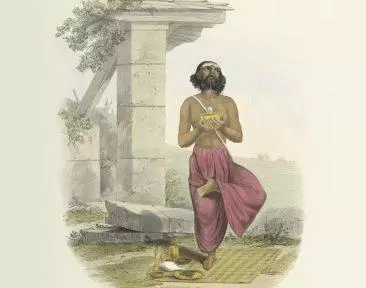
Priests and Prophets
Most religions have a founding prophet who acts as the first leader of the faith. For example, in Islam, Allah is said to have sent forth prophets to all parts of the world at different points in history. The Qur’an mentions twenty-five prophets by name but the actual number who received revelations is supposed to be significantly higher.

Sacred Books
Today, when we “live stream” something, we are receiving information from a faraway, invisible source. The fact is that all religious teaching and divine truth were believed to be essentially live-streamed into prophets and mystics, who were then expected to pass them on. The sacred texts of all religions are said to be the result of these direct revelations.

Sectarian Splits
Religion is all about oneness and unity. It is one of the greatest ironies in human history that it is through the medium of religion that the biggest divisions take place – not just between faiths, but even within the faith. This has happened almost uniformly across religions.

Seeing Order in the Universe
This is the second in a series of articles on commonalities across religions. In the introductory article for this series, we refer to these commonalities as “common threads” because they are woven throughout human history and reflect the fact that we are all made of the same fabric. However, there is great diversity and beauty in the many different colors of dye observed across cultures and belief systems.

Sharing A Milestone Event In Uef’s Amazing Journey
We are thrilled that our bi-weekly Wisdom newsletter has reached a milestone, currently reaching over one million readers across 1,000 higher education institutions in America. We have shared 108 commonalities across world religions that we’ve researched from these biweekly letters

16 topics — scroll to see all