Learn
Watch Videos on Learn
Learning about Learning - a deep dive
“It is not knowledge but the act of learning, not possession but the act of getting there, which grants the greatest enjoyment.” – Carl Friedrich Gauss
“Learning never exhausts the mind,” Leonardo da Vinci
Learning is integral to what it means to be alive. We can distinguish that which is living from that which is not living based on whether the object has the ability to learn. A stone, a grain of sand, or any other inanimate object cannot learn.
Life, on the other hand, fights against entropy and disorder. The great physicist Erwin Schrödinger described this property of life as “negative entropy,” which is the ability to turn disorder into order.
Like loving and playing, learning is truly infinite. Each answer gives rise to new questions and provides opportunities for new learning. If we remain curious, it leads us toward our connection to infinity.
“The more I know, the more I realize I know nothing.” Socrates compared what he knew to the vastness of what remained unknown. Just as there is near-infinite knowledge available to us, there is also an equally infinite amount of knowledge about the universe that nobody has at this time.
Knowledge about the outside world is just one form of learning. Sages throughout history stressed the importance of the examined life: learning that has to do with knowing oneself and using this knowledge to constantly improve oneself.
As Confucius explained, we often learn some things and study others. Learning changes the learner directly; study deepens knowledge of the subject. Both matter, but learning in the fuller sense transforms who we are.
In our day-to-day lives, learning manifests differently depending on the developmental stage of our lives.

Learning Across Life Stages
During early childhood, learning often occurs through exploration, play, and social interactions. Young children learn through their senses, movement, imitation, and relationships with caregivers and peers.
Childhood
In middle childhood, learning becomes more formalized. Children acquire literacy and numeracy, begin engaging formal subjects, and develop critical thinking, logical reasoning, and emotional intelligence.
Adolescence
During adolescence, learning involves increased cognitive complexity and abstract thinking. Adolescents are exposed to more complex subjects while developing identity, values, self-awareness, and decision-making.
Adulthood
Learning in adulthood can occur through formal education, work experiences, personal interests, and life experience. Adults continue adapting through new roles, responsibilities, and opportunities for growth.
Robert Kegan’s work on adult development frames humans as meaning-making beings. Learning is not just acquiring information; it is also growth in how we make sense of ourselves and the world.
We learn differently at different stages of life because our horizons, conceptual frameworks, and cognitive tools keep expanding. Learning radiates outward from self-knowledge toward the physical and transcendent worlds.
Beyond Institutional Learning
Spiritual learning involves awareness of the transcendental aspects of existence and the existential questions that come with them: why are we here, what is the meaning of life, and what lies beyond our current understanding?
On a metaphorical level, learning is coming to understand the truth behind the stories we tell ourselves. Many of those stories are best understood not as literal expressions, but as symbolic expressions of deep truths.
At its deepest, learning can become an expression of love. True learning brings humility, gratitude, appreciation for diversity and interconnectedness, and the wisdom to pass that perspective to others.
The Ease of Learning, and Importance of Unlearning
We learn from people, books, and experiences. Reading, conversation, and experimentation each expand the range of what we can perceive and understand.
Human learning is also cooperative. The parable of the blind men and the elephant illustrates how partial perspectives become fuller when shared with others.
True learning also requires unlearning. Our assumptions are like windows on the world, and if we do not clean them, the light stops coming in.
Our perceptions do not simply mirror reality as it is; they are constructions of mind. Learning means becoming aware of those constructions and revising them when the world or wiser perspectives demand it.
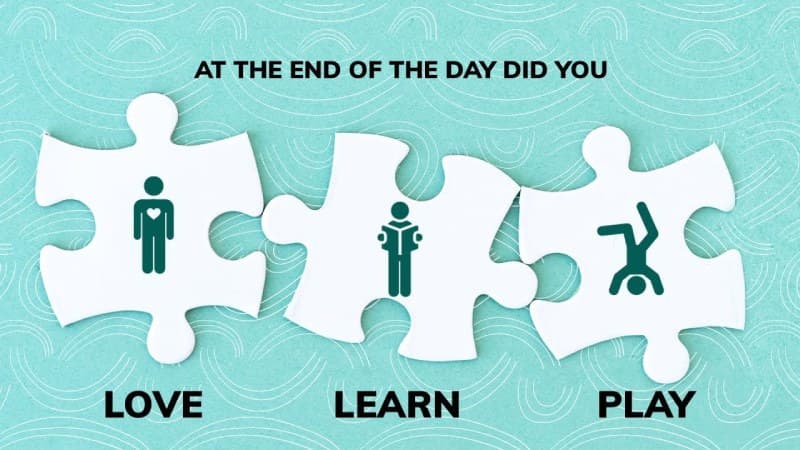
Living with a Love, Learn, Play approach changes who we are, not just what we know. It turns learning from accumulation into transformation.